
How the Internet of Things in smart cities Powers Smarter, More Connected Urban Environments



We have all heard about smart cities somewhere, whether in an article, a movie, or from friends or family, but what does it really mean? What makes a city truly smart? Can we call a city smart if only its buildings are shiny, made of glass, with unusual designs? Actually, what makes a city smart is not just the technology, but how that technology is used to solve everyday challenges.
At their core, smart cities are designed to be more connected, more responsive, and more focused on the needs of people. What makes this possible is the Internet of Things (IoT). Smart city urban planning involves IoT devices that create a network of physical objects equipped with sensors, connectivity, and software, allowing them to collect and exchange data. Think of it as giving ordinary objects the ability to observe the world and communicate with each other.
Smart real estate developments are integrating the Internet of Things in smart cities because it has a significant and impressive impact on city life.
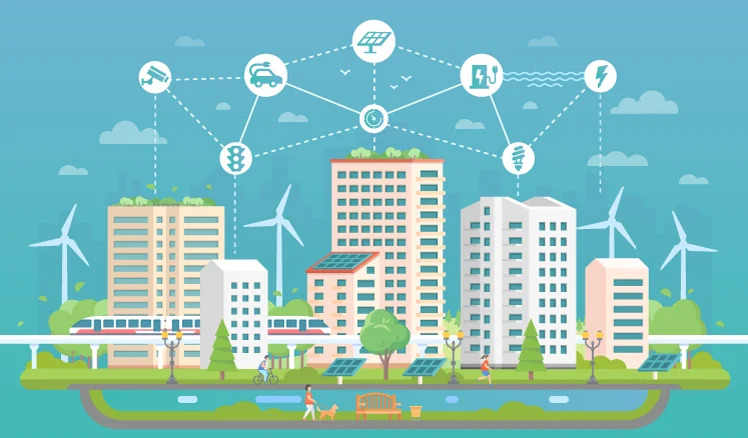
How the Internet of Things in Smart Cities Integrates into Urban Systems: Traffic, Utilities, and Waste Management
The Internet of Things in smart cities organizes city services to make urban living easier and more efficient for residents.
In the transportation sector, IoT devices can monitor vehicle performance, optimize routes, and track shipments. They also track the condition of cargo to ensure it arrives at its destination in optimal condition.
Government-owned utilities use IoT applications to notify users of widespread outages in water, power, or sewer services. These applications collect data on the scope of an outage and help deploy resources, allowing utilities to recover more quickly.
Waste management companies benefit greatly from IoT. Connected sensors and devices track the location, quantity, and quality of waste, helping to reduce the risk of contamination and illegal dumping.
The Internet of Things in smart cities is not just an addition; it is what truly makes a city smart.
IoT improves energy use, maintenance, and digital connectivity in cities
The Internet of Things in smart cities transforms urban life by taking the chaos out of it. With IoT as the brain and sensors as the senses, city systems can see, think, and act.
Utility systems that use IoT sensors can automatically adjust lighting, heating, ventilation, and cooling based on actual occupancy or ambient conditions. For example, when there are no pedestrians in the street, the lights will dim because full brightness is not needed. This reduces energy consumption significantly.
The Internet of Things in smart cities does more than improve utility systems. It also enhances infrastructure efficiency through predictive maintenance. When a potential fault is detected, advanced systems can automatically generate work orders, schedule repair crews, and provide technicians with the detailed information they need before arriving on site. You might think this is not very important, but it actually reduces downtime, extends the life of infrastructure, and eliminates costly emergency repairs.
IoT in smart cities also unifies data platforms. Cities consolidate data from different IoT systems into shared analytics platforms, which makes it easier to coordinate services from waste management to electric grids without siloed information. With this unified view, planners and administrators can clearly see the overall performance of the city.

The Internet of Things in Smart Cities and the Future of Urban Safety: Surveillance and Real-Time Response
The Internet of Things in smart cities is becoming core infrastructure for public safety. It is central for governments and agencies to protect people and critical infrastructure.
Cities are growing rapidly, and higher population density means more complex infrastructure to oversee. Smart cities face this challenge by integrating connected surveillance cameras, road sensors, and traffic monitoring systems. The purpose of these tools is to help authorities track movement, detect incidents, and maintain order in busy urban environments. Using a coordinated network of IoT devices that provide real-time insights into what is happening across roads and public spaces is far better than relying on scattered and outdated systems.
Governments are taking an active role in smart, connected infrastructure by developing and deploying cloud-based platforms that support IoT systems. These platforms allow cities to store, process, and analyze massive amounts of data collected from IoT devices. Without them, integrating information from departments such as police, transportation, healthcare, and utilities would be extremely difficult.
How Sharjah Is Advancing the UAE’s Smart City Vision
UAE smart cities are taking the term “smart” to the next level with their off plan projects. While cities such as Dubai and Abu Dhabi are well known for their advanced smart city initiatives, Sharjah is steadily carving out its own identity within this movement by focusing on sustainable growth, digital accessibility, and citizen-centric services.
A major part of Sharjah’s transformation efforts includes the development of online digital systems that simplify administrative processes for residents, businesses, and visitors. At the same time, investment in smart infrastructures, such as intelligent traffic systems, automated utility monitoring, and environmentally conscious planning, demonstrate Sharjah’s ongoing shift toward data-driven urban governance.
An example of Sharjah’s smart city projects is District 11, which is emerging as a leading commercial hub. It is expected to become a prime destination for people seeking a modern and smart environment to launch or expand their projects.

How the Internet of Things in smart cities Is Driving Real Estate Value and Urban Competitiveness
IoT-driven developments act as a magnet for people, which is entirely understandable because these developments create environments that make life easier and more convenient.
If smart homes and buildings are equipped with IoT-enabled systems that automate lighting, temperature control, and security, residents no longer need to adjust these systems manually. These conveniences save time, reduce stress, and cut energy costs, making properties significantly more attractive to potential buyers.
On a city-wide scale, IoT in smart cities greatly improves urban mobility and public services. Connected traffic systems and real-time public transportation tracking reduce commuting times and congestion, enhancing the city's overall livability.
From a real estate perspective, this increased livability translates into higher demand and stronger property values. People are willing to pay premium prices for homes and commercial spaces in IoT-integrated areas because of the comfort, convenience, and safety they offer. Developers and investors recognize that properties within smart, connected neighborhoods attract long-term tenants and maintain value better, which makes investment in IoT-enabled urban areas more secure and profitable.

Frequently Asked Questions
1. What is a smart city, and how does IoT make it smart?
A smart city uses technology to improve efficiency, safety, and quality of life, with the Internet of Things in smart cities playing a central role. IoT devices collect and share data to optimize traffic, energy, and public services.
2. How is Sharjah contributing to the UAE’s smart city initiatives?
Sharjah focuses on sustainable growth, digital services, and smart infrastructures, with the Internet of Things in smart cities powering intelligent traffic systems, automated utilities, and projects like District 11.
3. What role does IoT play in urban safety?
The Internet of Things in smart cities enables real-time surveillance, traffic monitoring, and emergency coordination, allowing cities to detect incidents quickly and respond effectively.
4. What role does IoT play in urban safety?
The Internet of Things in smart cities improves urban safety through real-time surveillance, incident detection, and coordinated emergency responses.
5. Why are cloud-based platforms important for smart city IoT?
Cloud-based platforms are essential for the Internet of Things in smart cities because they store and process IoT data, enabling city departments to coordinate efficiently and provide better services to residents.
Latest News

24 Apr, 2026

26 Mar, 2026

26 Mar, 2026
25 Mar, 2026

24 Mar, 2026

23 Mar, 2026

16 Feb, 2026

16 Feb, 2026

16 Feb, 2026

16 Feb, 2026

Book a Free Consultation
One of our experts will get in touch within 24 hours to book an appointment.